Table of Contents
- Why Crooked Teeth Need More Than a Cosmetic Fix
- Best Braces for Crooked Teeth: Metal or Ceramic.
- Clear Aligners for Crooked Teeth: Who They Suit Best
- How Long Does It Take to Straighten Crooked Teeth?
- Treatment for Severely Crooked Teeth: When Simple Options Fall Short
- Cost, Insurance, and Total Out-of-Pocket Planning
- Choosing the Best Orthodontic Treatment for Crooked Teeth
- Frequently Asked Questions
Last Updated: October 21, 2026
Why Crooked Teeth Need More Than a Cosmetic Fix
Crooked teeth are one of the most common reasons people seek orthodontic treatment, and the best orthodontic treatment for crooked teeth depends on your bite, your age, and how much movement is needed. At Schatz Orthodontics, patients often assume straightening is only about looks, the health story matters just as much.
Misaligned teeth are harder to clean. They trap food, wear unevenly, and can strain the jaw joint over time. The American Association of Orthodontists recommends that children get a first orthodontic checkup by age 7, because early signs of bite problems are easiest to guide while the jaw is still growing.
Causes and Types of Crooked Teeth
Crooked teeth usually come from genetics and habit: a small jaw, extra teeth, or early loss of baby teeth can crowd adult teeth, while thumb sucking or tongue thrusting can push teeth out of line.
The main types we treat:
- Crowding: not enough room, so teeth overlap or rotate
- Spacing: gaps between teeth
- Overbite and overjet: top teeth sit too far forward
These are all forms of malocclusion, the clinical term for a bite that does not line up correctly, ranging from one isolated crooked tooth to severe cases affecting the whole bite.
How Crooked Teeth Affect Oral Health
Straight teeth are easier to keep clean, and that is the core health benefit. Crowded teeth trap plaque where a toothbrush cannot reach, raising the risk of cavities and gum disease, and a misaligned bite can wear enamel unevenly and cause jaw soreness. That is why we treat the bite and the smile together.
Best Braces for Crooked Teeth: Metal or Ceramic.
Braces remain the most reliable way to move teeth, especially for moderate to severe cases.
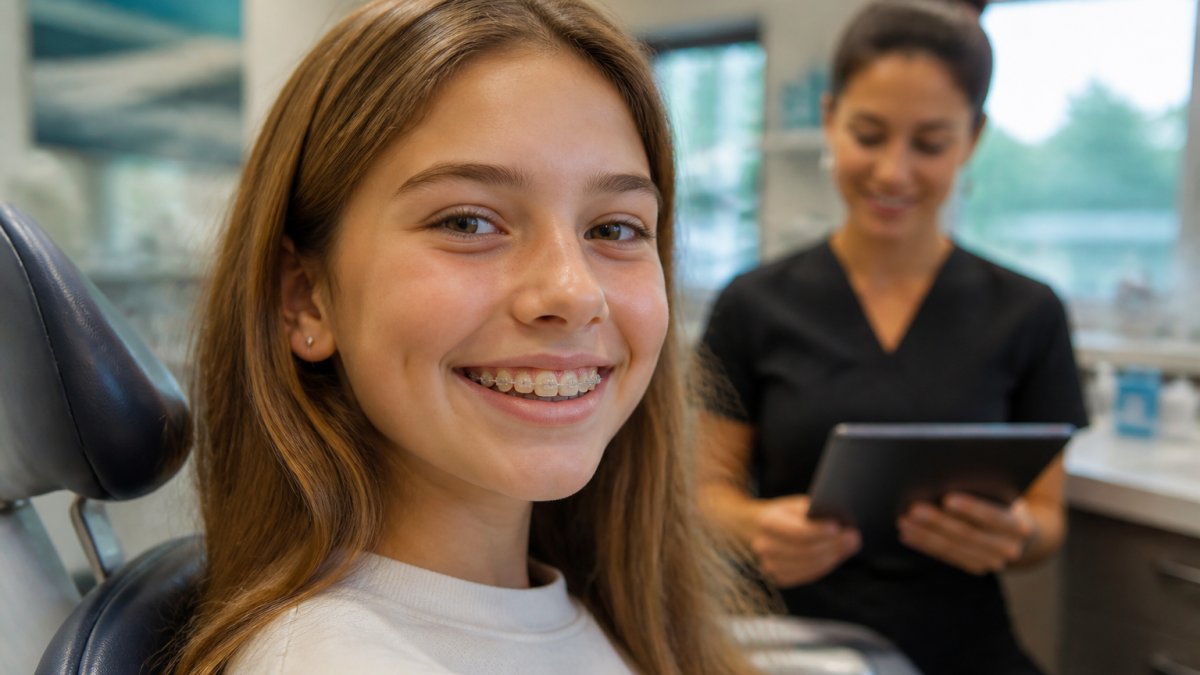
Traditional Metal Braces
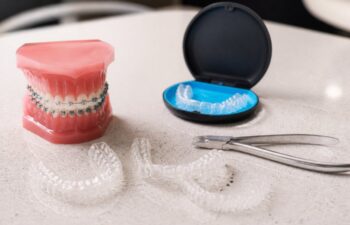
Metal braces use brackets and wires to apply steady, light pressure that moves teeth into place. They are the most common and proven choice. Brackets are also smaller than most adults remember, and they handle complex crowding, rotation, and bite problems well. The trade-off: they are visible and fixed, so cleaning around each bracket takes care.
Ceramic Braces
Ceramic braces work like metal ones but are tooth-colored. This choice is popular with adults and teens who want a less noticeable appliance.
|
Option |
Visibility |
Best For |
Watch Out For |
|---|---|---|---|
|
Metal braces |
High |
Severe crowding, complex bites |
Cleaning around brackets |
|
Ceramic braces |
Low to moderate |
Adults wanting a subtle fixed option |
Staining, higher cost |
|
Clear aligners |
Very low |
Mild to moderate cases |
Discipline with wear time |
Clear Aligners for Crooked Teeth: Who They Suit Best
Clear aligners are removable trays that shift teeth in planned stages. Nearly invisible and removable for eating and brushing, they are often a favorite for adults.
They work best for mild to moderate crowding, spacing, and minor rotation; severe cases or complex bite problems may need the control of braces. Success with aligners requires good compliance, and work best if worn about 22 hours a day. They work well for our teenage patients as well, but younger patients may need support to stay on track.
How Long Does It Take to Straighten Crooked Teeth?
Treatment length varies by case. Mild crowding with aligners often finishes faster than complex bite correction with braces, and severe cases take longer because more teeth and both jaws may need to move.
Typical ranges:
- Minor orthodontic issues: often under a year
- Moderate cases: roughly 12 to 24 months
- Severe cases: often 24 months or longer
Your orthodontist will give a specific estimate after a consultation and imaging. The National Institute of Dental and Craniofacial Research notes that regular professional follow-up is part of safe, effective orthodontic care.
Treatment for Severely Crooked Teeth: When Simple Options Fall Short
Severe crowding, impacted teeth, or a jaw that does not line up often need more than aligners. Braces give the control to move teeth safely, and some patients need a team approach.
Treatment for severely crooked teeth may involve:
- Extractions to create room in a crowded mouth
- Palatal expanders for children whose upper jaw is too narrow
- Jaw surgery in adult cases where the bite cannot be corrected with braces alone
A board-certified orthodontist can judge which cases need this level of care. At Schatz Orthodontics, Dr. Eric Schatz brings more than 20 years of experience with cases from minor alignment issues to severe malocclusions, and we plan each case around the individual bite.
Cost, Insurance, and Total Out-of-Pocket Planning
Cost is the question we hear most, and the honest answer is that it depends on your case, treatment type, and insurance. We do not publish flat prices because a simple aligner case and a complex surgical case are not the same job, but here is exactly what drives the number so you can compare plans apples to apples.
What Actually Drives the Fee
Orthodontic fees are built from a few independent components:
- Records and imaging: panoramic X-rays, cephalometric films, intraoral scans, and photographs, usually bundled into a comprehensive case fee but sometimes charged separately for limited treatment.
- Appliance type: metal braces are typically the least expensive fixed option; ceramic brackets cost more; lingual braces cost more again for customization and chair time; clear aligners depend on the number of trays and whether mid-course corrections are included.
- Complexity: single-tooth alignment, mild crowding, and full-arch bite correction are different jobs. Extractions, palatal expansion, temporary anchorage devices, and jaw surgery add fees on top.
How Dental Insurance Handles Orthodontics
Dental plans vary, but a few patterns are common:
- Orthodontic coverage is often a separate lifetime maximum, frequently lower than the annual maximum for general dental care, and it does not reset once used.
Age limits are common. Many plans cover children up to a certain age and offer reduced or no benefits for adults. Confirm the cutoff before assuming coverage.
Questions to Ask Before You Sign
- Ask for a written treatment plan with the full fee, not a monthly payment alone. The monthly number is a financing figure, not the price.
- Ask what the fee includes: records, adjustments, retainers, retainer replacements, and emergency visits.
- Ask what is excluded, such as extractions, surgery, or specialist consultations.
- Ask what happens if treatment runs long or if you miss appointments. Some contracts extend payments; others do not.
- Ask about payment plans and third-party financing, including whether interest or fees apply.
- Ask how insurance claims are filed and whether the practice submits them or you do.
Choosing the Best Orthodontic Treatment for Crooked Teeth
There is no single best option for everyone. The right choice depends on four things: crowding severity, whether the bite is affected, your age, and how visible you are willing to let treatment be. Here is how clinicians sort cases.
Start With the Diagnosis, Not the Appliance
The appliance is the last decision, not the first. A proper exam answers three questions:
- Is this a tooth-position problem or a jaw-position problem? Crooked teeth from crowding are a tooth-position issue. An underbite or a narrow upper jaw is a jaw-position issue, and jaw problems often need growth modification, expansion, or surgery rather than aligners alone.
- Is the bite functional or only cosmetic? A bite that wears enamel, strains the jaw joint, or traps food is a health issue. Mild cosmetic irregularity without functional problems is a different conversation.
- How much controlled movement is required? Single-tooth rotation, bodily translation, and bite correction place different demands on an appliance.
Matching Severity and Bite Problem to Treatment
- Mild crowding or spacing, no bite issue: clear aligners or limited braces are often appropriate. Aligners work well when teeth need tipping and small rotations rather than complex bodily movement.
- Moderate crowding with rotations: braces generally give more predictable control of rotation than aligners, though aligner systems with attachments can handle many moderate cases.
- Severe crowding: extraction of premolars may be needed to create room, and fixed braces are usually the most reliable way to close and control the spaces.
When Cosmetic Fixes Are the Wrong Tool
Veneers, bonding, and crowns change the shape and surface of teeth; they do not move teeth or correct a bite. They suit a chipped or slightly irregular tooth in an otherwise healthy bite, but are a poor choice when crowding causes gum inflammation, the bite wears enamel unevenly, or rotation would require aggressive enamel removal to mask.
A Practical Decision Path
- Get a full orthodontic exam with imaging. A visual check is not enough to judge severity or jaw position.
- Ask whether your case is primarily tooth-position or jaw-position. This single answer rules options in or out.
- Ask what the appliance must accomplish, tipping, rotation, bodily movement, space closure, or bite correction, and which options can deliver that reliably.
- Weigh trade-offs: visibility, removable vs. fixed, cleaning difficulty, comfort, treatment length, and total cost including retention.
- Confirm retention. Whatever you choose, teeth drift. A retainer plan is part of the treatment, not an add-on.
The American Dental Association recommends regular dental visits, and an orthodontic consultation is the next step when alignment is a concern. A board-certified orthodontist can confirm which treatment suits your bite and rule out options that will not deliver a stable result.
Frequently Asked Questions
What is the most effective treatment for crooked teeth?
There is no single best option for everyone. Metal braces remain the most predictable way to correct crowding, rotation, and bite problems, especially in moderate to severe cases. Clear aligners work well for mild to moderate crowding in disciplined patients. A board-certified orthodontist can assess your bite, tooth position, and goals during a consultation, then recommend the treatment plan most likely to produce a stable, healthy result for your specific case.
Are clear aligners effective for crooked teeth?
Clear aligners for crooked teeth work best when crowding is mild to moderate and the patient wears them about 20 to 22 hours a day. They struggle with severe rotations, large gaps, and complex bite problems that need precise tooth movement. If you skip wear time, treatment stalls. An orthodontist can tell you during a consultation whether aligners can handle your case or whether braces will give a more reliable outcome.
How long does it take to straighten crooked teeth?
Treatment length depends on how crooked the teeth are, which option you choose, and how well you follow instructions. Minor crowding may resolve in several months with aligners, while moderate to severe cases often take 18 to 24 months or longer with braces. Complex bite problems and cases needing jaw coordination can run past two years. Your orthodontist will give a projected timeline after reviewing imaging and building a treatment plan.
Can adults get orthodontic treatment for crooked teeth?
Yes. Adults make up a growing share of orthodontic patients, and age alone does not disqualify anyone. Adults often choose ceramic braces or clear aligners for a less noticeable look at work. The main differences are that adult bones are no longer growing and gum health needs closer monitoring, so a thorough exam matters. A board-certified orthodontist can build a plan around your bite, lifestyle, and appearance concerns.
Crooked teeth are treatable at any age, and the right plan protects both your smile and your oral health. If you are unsure which option fits your case, guessing is the wrong move. Get an expert opinion first. Schatz Orthodontics offers board-certified care, a compassionate, family-friendly team, and treatment plans built for children, teens, and adults alike. Schedule an appointment with Schatz Orthodontics and get a clear, honest plan for a straighter smile.
Posted on behalf of
22610 US Highway 281 North, Suite 201
San Antonio, TX 78258
Phone: (210) 494-4606